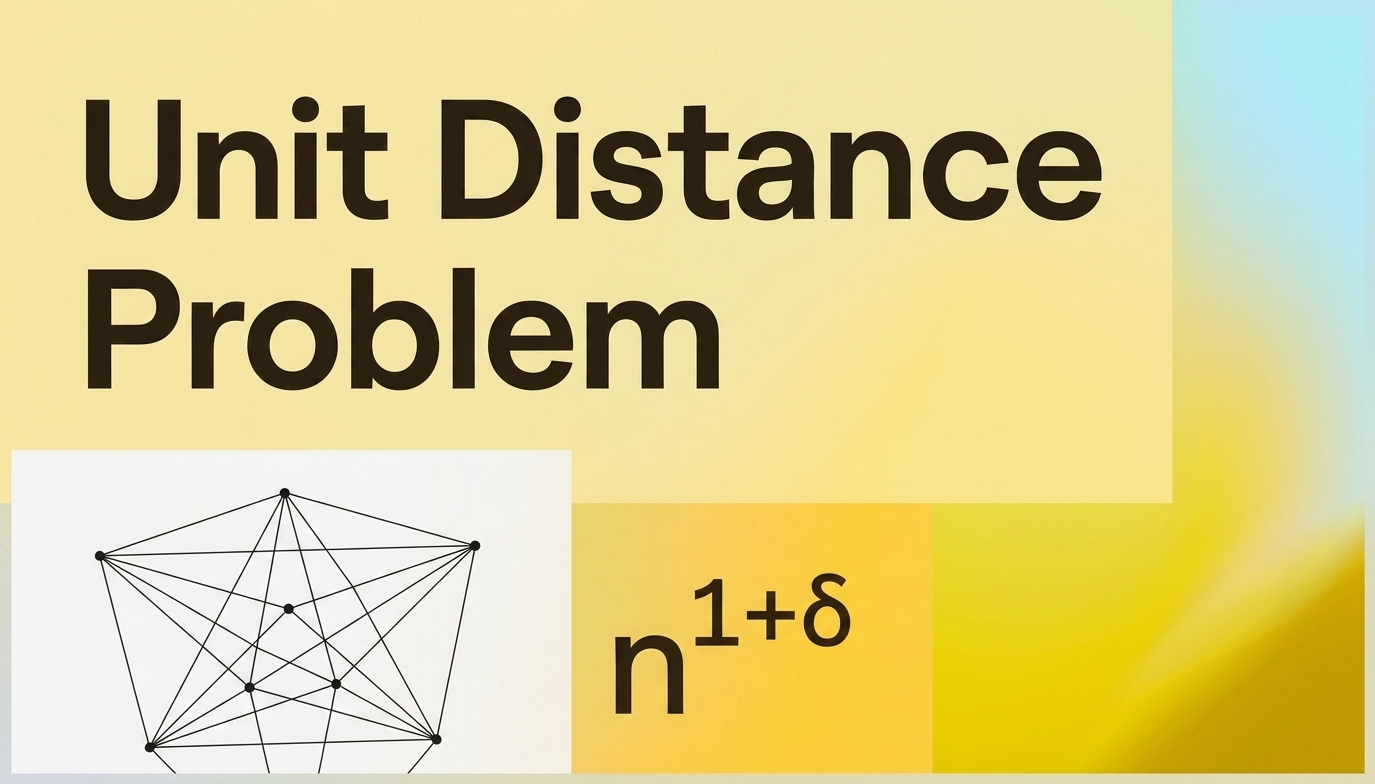
OpenAI says an internal general-purpose reasoning model has disproved the Erdős unit distance conjecture, a central problem in discrete geometry posed in 1946
For nearly 80 years, mathematicians have studied a deceptively simple question: if you place nnn points in the plane …
Lead Source
How this story grew
More
Discussion
TechSnif Coverage
OpenAI Model Disproves 1946 Math Conjecture
An internal OpenAI reasoning model has disproved the Erdős unit distance conjecture from discrete geometry.
OpenAI claims one of its internal general-purpose reasoning models has disproved the Erdős unit distance conjecture — a central problem in discrete geometry first posed in 1946.
The conjecture, formulated by legendary mathematician Paul Erdős, deals with unit distances in discrete geometry. OpenAI has published both the proof and companion remarks for public review.
What makes this notable: the model that cracked it isn't a specialized math system. It's described as a general-purpose reasoning model, suggesting OpenAI's AI capabilities are reaching into territory traditionally reserved for human mathematicians working on foundational problems.
The company has made the full proof available online. Whether the broader mathematics community validates the result remains to be seen — but if it holds up, an AI just knocked down a nearly 80-year-old open problem in mathematics.